What exactly is a skink?
A lizard, first of all. Then a member of one of the largest, most widespread and most varied reptile families on Earth.
The family
Skinks belong to the family Scincidae, within the lizards (Squamata, the same order as snakes). A 2023 global review by David Chapple and colleagues counted 1,743 described species, about 24% of all lizards, with around 20 more described each year. That makes Scincidae the largest lizard family, just ahead of the true geckos (Gekkonidae). Their centres of diversity are Australia, New Guinea, South-East Asia, the Pacific islands, Madagascar and southern and central Africa.
The name comes, via Latin scincus, from the ancient Greek skinkos. That was originally the name for one particular North African desert lizard, the sandfish, Scincus scincus, which classical writers described and which was later sold as a medicine.
Not everyone groups skinks the same way. In 2014, the American biologist S. Blair Hedges proposed splitting Scincidae into nine separate families, among them Egerniidae for the blue-tongues and their relatives, Mabuyidae and Lygosomidae. Other researchers prefer to treat these as subfamilies within one big family. The animals are the same either way; only the filing system differs. On this site we use the broad, traditional Scincidae.
How a skink is built
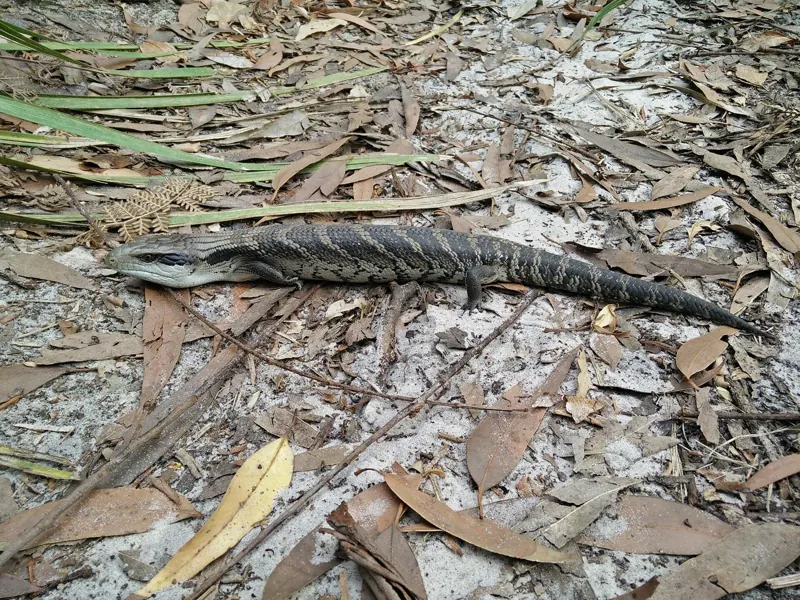

The typical skink is easy to describe and easy to overlook: a long, cylindrical body, a head that blends into it with little or no visible neck, short legs, and a tail that tapers smoothly away. Many species look as if they have been dipped in varnish.
That gloss comes from the scales. Skinks have smooth, rounded, overlapping scales, a bit like roof tiles or fish scales. Inside each one sits a small, compound plate of bone called an osteoderm, with a pattern of plates that is one of the defining features of skinks. Together they form a flexible suit of armour.
Other common features:
- Eyelids. Unlike snakes and most geckos, most skinks can blink. Many have a transparent “window” in the lower eyelid so they can see with their eyes closed. In the snake-eyed skinks, that window is fixed permanently over the eye.
- A detachable tail. Most skinks can shed their tail to escape a predator and regrow it later (see tails).
- Flexible limb plans. Skinks range from fully five-toed, four-legged runners to animals with tiny vestigial limbs or none at all.
- A forked-tip tongue used to taste the air, though not as deeply forked as a monitor lizard’s.
Sizes vary enormously. The smallest limbed skink, Scincella macrotis, has a body only about 2.4 cm long. At the other end, the heaviest is Australia’s land mullet, Bellatorias major, at around 1.5 kg, with the biggest blue-tongues close behind. Counting the tail, the Solomon Islands skink reaches about 70–80 cm.
Where skinks live
Skinks are found on every continent except Antarctica, and on a remarkable number of oceanic islands. They are especially diverse in:
- Australia, with well over 400 species, more than any other lizard family there. Skinks are the dominant small reptiles of almost every Australian habitat.
- Sub-Saharan Africa and Madagascar, with their own large radiations, including many burrowing and limb-reduced species.
- South and South-East Asia, New Guinea and the Pacific islands, home to green-blooded skinks, tree skinks and the ocean-crossing Emoia.
- The Americas, with fewer species but some famous ones, such as the five-lined skinks of North America and the placenta-bearing Mabuya of South America.
- New Zealand, which has a remarkable radiation of around 100 native skink taxa (described and undescribed), all found nowhere else and nearly all of them live-bearing.
Europe is comparatively skink-poor, with a handful of species around the Mediterranean and the Balkans, such as the snake-eyed and three-toed skinks. Britain, Ireland and the Isle of Man have none. The slow-worm, often mistaken for one, belongs to a different family.
Habitats
If you can name a land habitat in the warm and temperate world, a skink probably lives there:
- Deserts and dunes: sand-swimmers such as the sandfish and many Australian sliders.
- Grasslands: from the pygmy blue-tongue in old spider holes to the three-toed skink weaving through Italian meadows.
- Rainforest floors: fire skinks and countless small litter skinks.
- Tree trunks and canopies: emerald tree skinks, green-blooded skinks and the leaf-eating Corucia.
- Rock outcrops: grand skinks on Otago schist, Cunningham’s skinks and gidgee skinks in crevices.
- Coasts and islands: many skinks live on small offshore and oceanic islands.
- Towns and gardens: blue-tongues in Sydney back gardens, striped skinks on African walls.
What skinks eat
Most skinks are insectivores, hunting insects, spiders, worms, snails and other invertebrates. Larger species tend to be omnivores. Blue-tongues and shinglebacks eat snails, beetles and carrion alongside flowers, fruit and soft plants. A few, such as the Solomon Islands skink, are entirely herbivorous.
On islands with few mammals, lizards, skinks among them, can be important pollinators and seed dispersers, a pattern reviewed by Jens Olesen and Alfredo Valido in 2003. New Zealand’s grand and Otago skinks, for example, eat fleshy fruits as well as insects.
Behaviour
Skinks, like all reptiles, are ectotherms. They get their body heat from the environment rather than generating it internally. Much of a skink’s day is spent managing temperature: basking in the sun or on warm rock, then retreating to shade or a burrow before overheating. In cooler regions many species brumate (the reptile version of hibernation) through winter.
Most are active by day, though some, such as the Solomon Islands skink, are active mainly at dusk and at night. Many are secretive and spend more time under cover than in the open. A good deal of skink research involves turning over rocks and logs, and putting them carefully back.
Social life ranges from solitary to surprisingly sophisticated. Several Australian Egernia and related skinks live in stable family groups for years, recognise each other by scent and share refuges and toilet sites. Shinglebacks form long-term pairs.
Senses
Skinks use their eyes, ears (most have visible ear openings, sometimes protected by small scale lobes) and, above all, chemical senses. The tongue collects scent particles and delivers them to the vomeronasal (Jacobson’s) organ in the roof of the mouth. That is how a blue-tongue follows the trail of a snail, or a male tracks a female across a paddock.
Lookalikes
Several unrelated animals are regularly mistaken for skinks: slow-worms and glass lizards (legless lizards of the family Anguidae), wall and common lizards (Lacertidae), and even salamanders, which are amphibians with soft, moist, scaleless skin. A smooth, glossy, tight-scaled lizard with small legs and little neck is very likely a skink. A matt, soft-skinned creature by a stream is probably a salamander.