Skinks in trouble, and some good news
Most skink species are not considered threatened, but island skinks have suffered some of the worst reptile losses of modern times.
Many widespread skinks, including most of the species in our field guide, are listed as Least Concern on the IUCN Red List. Plenty of others have never been properly assessed, because they are small, secretive and live in places few herpetologists visit. The species in real danger tend to share a profile: a small range, often on an island, and exposure to predators they never evolved alongside.
The main threats
- Introduced predators: cats, rats, stoats, ferrets, mongooses and invasive snakes.
- Habitat loss: clearing of native grassland and forest for farming, logging and building.
- Invasive insects: on Christmas Island, invasive yellow crazy ants transformed the forest ecosystem.
- Collection for trade: some species, including the Solomon Islands skink, have been hit by heavy export for the pet trade.
- Suburban hazards: dogs, cats, lawnmowers, cars and slug pellets.
- Climate change: shifting temperatures and fire regimes affect animals that depend on precise conditions.
Christmas Island: a warning
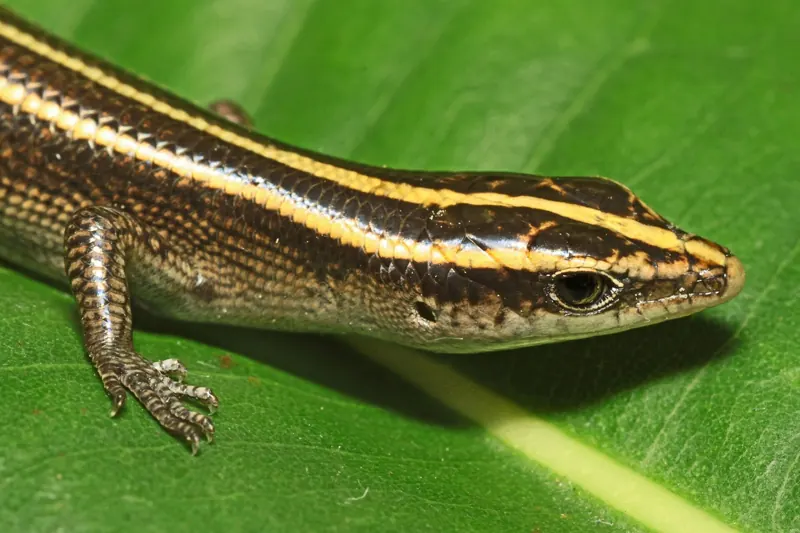

Christmas Island, an Australian territory in the Indian Ocean, had six native reptiles. Four that were common and widespread until at least 1979 had disappeared from the wild by 2012. The Christmas Island forest skink (Emoia nativitatis) was last seen in the wild in 2010. The last known individual, a female keepers called Gump, died in captivity on 31 May 2014. It was listed as Extinct by the IUCN in 2017, and in 2021 the Australian Government formally recognised it as the first Australian reptile known to have died out since European colonisation.
The Christmas Island blue-tailed skink (Cryptoblepharus egeriae) very nearly followed. In 2009–10, 66 were taken into captivity just before they vanished from the wild. Breeding programmes on the island and at Taronga Zoo in Sydney raised the captive population to more than 1,500 by 2018, and the species has been released on islands in the Cocos (Keeling) group (Pulu Blan in 2019, Pulu Blan Madar in 2020), where its main threats are absent. It is listed as Extinct in the Wild, but it still exists.
The cause of the collapse is not fully settled. In a 2021 expert assessment, the introduced common wolf snake (Lycodon capucinus) ranked as the most likely cause, because its spread across the island closely matched the pattern of lizard disappearances. Introduced giant centipedes ranked next, and yellow crazy ants may have made things worse.
The pygmy blue-tongue: found in a snake
Unrecorded for more than 30 years and thought extinct, the pygmy blue-tongue (Tiliqua adelaidensis) was rediscovered in 1992 inside a road-killed brown snake between Burra and Morgan, South Australia. It survives only in fragments of native grassland in the state’s Mid North and is listed as Endangered both by the IUCN and under Australia’s national law. Field trials have shown that the lizards readily move into artificial burrows, which may help populations persist. Profile →
New Zealand: predators and fences
New Zealand has no native land mammals apart from bats, and its skinks evolved without cats, rats or stoats. As a result, many are threatened. The grand and Otago skinks of Central Otago were once among the country’s most threatened reptiles. Decades of predator trapping, predator-proof fences at Macraes Flat and a new population at Mokomoko Sanctuary have reversed the decline, and in the 2025 national assessment both moved to “Threatened – Nationally Increasing”. It is proof that well-funded, patient conservation works. Profile →
Islands bounce back
When invasive animals are removed, skinks can recover dramatically. On Round Island, Mauritius, goats were eradicated in 1979 and rabbits in 1986. As the vegetation came back, the island’s reptiles recovered too, Telfair’s skink among them.
What you can do
- Never release pets, reptile or otherwise, into the wild.
- Buy only captive-bred reptiles, and ask questions about where they came from.
- In skink country, keep cats indoors (especially at dawn and dusk), avoid slug pellets and leave logs, rocks and leaf litter as shelter.
- Support organisations working on reptile conservation, and record sightings with local wildlife recorders or apps such as iNaturalist.
- On the Isle of Man, report common lizard sightings to Manx Wildlife Trust. Our own native reptile needs recording too.