Keeping a blue-tongued skink properly
A practical guide to the skinks most often kept as pets. It covers what they need, what goes wrong, and how to tell whether one is right for you before you buy.
- Is a skink right for you?
- Which species?
- Buying responsibly
- The law
- Enclosure
- Substrate & furnishings
- Heat & temperature
- UVB & lighting
- Humidity
- Diet
- Handling
- Health
- Finding a vet
- Other skinks in the hobby
- Kit list
- Checklist
Is a skink right for you?
Blue-tongued skinks have a deserved reputation as one of the better large lizards for committed beginners. They are usually calm, they tolerate gentle handling well, and they eat a varied diet without fuss. None of that makes them low-maintenance.
- Lifespan: commonly 15–20 years in good captivity, sometimes more. Plan for an animal that may outlast a house move, a new job or a child leaving home.
- Size: adults reach about 45–60 cm and need a large, heated enclosure for life.
- Running costs: electricity for heat and lighting, replacement UVB tubes, fresh food every week, and vet bills.
- Holidays: someone competent must feed them and check temperatures while you are away.
Which species?
Most blue-tongues kept outside Australia are one of these:
- Northern blue-tongue (Tiliqua scincoides intermedia) and eastern blue-tongue (T. s. scincoides): Australian, captive-bred in good numbers, robust, moderate humidity.
- Indonesian forms (T. gigas and related “Kei”, “Merauke” and other locality animals, with the Tanimbar blue-tongue T. s. chimaerea): from humid forest, needing higher humidity. Historically many were wild-caught imports.
- Blotched, western and other Australian species: rarely available outside Australia.
Australia has banned the commercial export of its native wildlife for decades, so Australian-species blue-tongues in Europe and North America descend from long-established captive-bred lines.
Buying responsibly
- Captive-bred only. Ask for hatch or birth date, parents and the breeder’s details. Avoid animals described as “imported”, “wild-caught” or “farmed”.
- See the animal before you pay. A healthy skink is alert, has clear eyes and nostrils, a rounded (not bony) tail base, clean vent, intact toes and no visible mites.
- Set up first. Have the enclosure built and running at the right temperatures for at least a few days before the skink arrives.
- Quarantine a new skink away from other reptiles. One reptile vet practice recommends at least three months, and six may be safer, with a vet check including parasite screening.
- Rehoming: reptile rescues regularly have blue-tongues needing homes. It is worth asking.
- Never release a pet skink, or any reptile, into the wild.
The law: check before you buy
Rules differ from place to place and change, so check the current position where you live:
- Isle of Man: the Island has its own legislation, separate from the UK’s. Check with the Department of Environment, Food and Agriculture (DEFA) before acquiring any exotic animal.
- England and Wales: no specific licence is needed for blue-tongued skinks, but the Animal Welfare Act 2006 places a legal duty of care on owners to meet an animal’s needs. Scotland and Northern Ireland have equivalent laws.
- Australia: keeping native reptiles generally requires a state or territory licence, and taking animals from the wild is not permitted.
- United States and elsewhere: state, provincial and local rules vary.
- International movement: Australia’s Tiliqua species and subspecies were listed on CITES Appendix III in 2022 (the pygmy blue-tongue moved to Appendix I in 2023), so moving animals across borders may need paperwork.
Enclosure
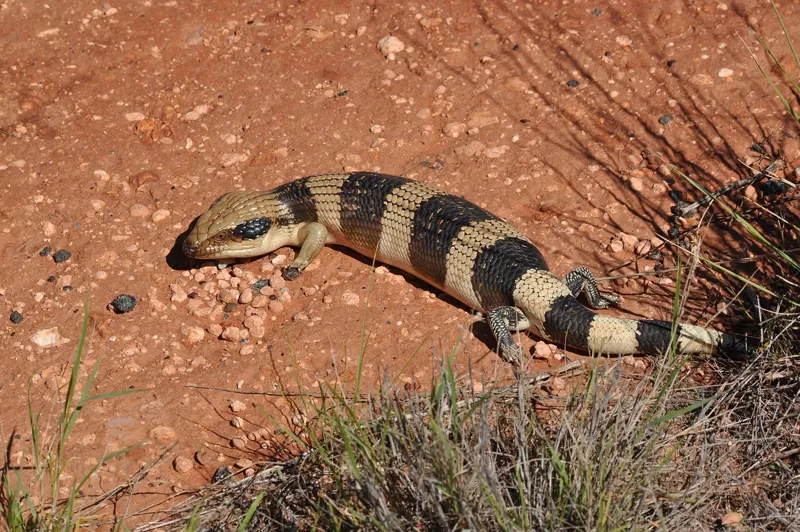

Blue-tongues are terrestrial, so give them floor space. As a widely used minimum for one adult:
| Animal | Minimum enclosure (L × W × H) | Notes |
|---|---|---|
| Adult blue-tongue | 120 × 60 × 60 cm (4 × 2 × 2 ft) | Bigger is better. One Australian vet care sheet recommends 120–180 cm long. |
| Juvenile | Can go straight into adult housing | Add plenty of cover so it feels secure. |
| Two adults | Not recommended | Blue-tongues should be housed alone. Even juveniles can fight and injure each other. |
Front-opening wooden or PVC vivariums hold heat and humidity well and are less stressful than top-opening tanks, where everything arrives from above like a predator. Ventilation matters, and lids and doors must lock: blue-tongues are surprisingly strong.
Substrate & furnishings
- Substrate: a deep layer, around 10–15 cm, of something diggable. A topsoil and play-sand mix (roughly 60:40) suits Australian species, while coconut fibre or a topsoil, coconut-fibre and play-sand mix holds humidity for Indonesian forms. Avoid pine and cedar wood products.
- Hides: at least two: a dry one at the cool end and a humid one, with damp moss, at the warm end.
- Basking surface: a flat stone or slate under the heat lamp. A rough surface also helps keep claws worn down.
- Enrichment: cork bark, logs, leaf litter and safe plants give them things to explore, dig and push through.
- Water: a heavy, shallow bowl they cannot tip, no more than about 7–8 cm deep, cleaned and refilled daily.
- Cleaning: spot-clean droppings and uneaten food daily, and replace or refresh substrate regularly.
Heat & temperature gradient
Skinks control their body temperature by moving between warm and cool areas, so the enclosure needs a gradient, not one uniform temperature. Typical targets for Australian blue-tongues:
| Zone | Target | How to measure |
|---|---|---|
| Basking surface | about 35–45 °C (95–113 °F); guides vary | Infrared temperature gun on the basking stone |
| Warm side (air) | about 29–32 °C | Digital thermometer probe |
| Cool side (air) | about 21–27 °C | Digital thermometer probe |
| Night | can fall to about 18–22 °C | No lights at night |
- Heat from above with a halogen flood bulb or similar, as the sun would.
- Every heat source must run through a suitable thermostat (dimming for bulbs).
- Use bulb guards, because burns are a common, avoidable injury.
- Check temperatures with your own instruments. Don’t trust the dial on the stat alone.
UVB & lighting
Blue-tongues are active in daylight and benefit from UVB, which lets them make vitamin D3 and use calcium properly. Without it, or without dietary D3 under careful vet guidance, they risk metabolic bone disease.
- Use a quality T5 high-output linear UVB tube running about half the enclosure length, mounted over the basking area.
- Aim for a moderate UV index of about 2–4 at the basking spot, with shade elsewhere. Strength depends on the tube and the mounting distance, so follow the manufacturer’s guidance, and ideally measure with a UV index meter.
- Glass and most plastics block UVB, so it must shine directly or through mesh.
- Replace tubes as the manufacturer recommends (often every 6–12 months), or test them with a UV meter. Output falls before the light visibly dims.
- Run lights for about 12–14 hours a day, on a timer. Some keepers shorten this a little in winter.
Humidity
| Type | Typical humidity |
|---|---|
| Northern / eastern (Australian) | about 40–60%, with a humid hide |
| Indonesian forms | about 60–80% |
Use a digital hygrometer. Raise humidity by dampening the lower substrate layer and the humid hide rather than soaking the surface. Persistently wet, stagnant conditions cause skin and respiratory problems, so balance humidity with ventilation. Stuck shed on toes and tail tips is often a sign that humidity is too low.
Diet
Blue-tongues are true omnivores. For adults, care guides suggest roughly half vegetables and leafy greens, no more than about 10% fruit, and the rest animal protein. Juveniles need proportionately more protein. Guides vary, and variety matters more than exact percentages.
| Food group | Good choices | Avoid or limit |
|---|---|---|
| Greens & veg | Collard, turnip, mustard and dandelion greens, endive, dandelion and hibiscus flowers, squash, bell pepper, grated carrot | Avocado, onion, aubergine (eggplant), and toxic plants such as buttercup, azalea, daffodil and tulip |
| Protein | Roaches, locusts, silkworms, earthworms, black soldier fly larvae, farm-raised snails, egg | Fireflies, scorpions; superworms only as a treat |
| Fruit | Blueberries, raspberries, strawberries, peach, pear (small amounts) | Citrus, rhubarb, seeds and stones |
- Frequency: babies and young juveniles are fed daily or nearly so. Adults need less often: guides range from every one to two days to once or twice a week. Adjust to body condition, because obesity is a common problem.
- Supplements: dust insects with plain calcium, and use a reptile multivitamin as the label directs, or as your vet advises. Complete commercial reptile diets and pet foods are already fortified, so don’t add a multivitamin on top.
- Some keepers include a small proportion of high-quality wet pet food. Opinions differ, so ask your vet.
- Always provide fresh water.
Handling
- Give a new skink time to settle in before handling.
- Support the whole body, including the middle, and never lift by the tail.
- Keep sessions short at first, and sit low to the ground so a slip isn’t a fall.
- Hissing, puffing up and flashing the tongue mean “back off”. Respect it.
- Supervise children closely.
- Wash your hands afterwards. Reptiles can carry Salmonella without looking ill, which matters most for children under five, adults over 65 and anyone with weakened immunity.
Health: warning signs
| Sign | Could indicate | What to do |
|---|---|---|
| Bubbles from the nose or mouth, wheezing, open-mouth breathing | Respiratory infection | Vet promptly; check temperatures |
| Soft or swollen jaw, tremors, bowed limbs, weakness | Metabolic bone disease | Vet; review UVB and calcium |
| Rings of old skin on toes or tail tip | Retained shed (often low humidity) | Raise humidity; vet if tissue is constricted |
| Tiny moving dots around eyes, ears or vent | Mites | Vet treatment and full enclosure clean |
| Weight loss, sunken eyes, refusing food for a long time (outside brumation) | Parasites, dehydration, illness | Vet, with a faecal test |
| Swelling, redness or cheesy material in the mouth | Mouth infection (stomatitis) | Vet |
| Runny, bloody or very smelly droppings | Parasites or infection | Vet, and take a fresh sample |
| Very wide body, fat folds, reluctance to move | Obesity | Review diet and feeding frequency with vet |
| Pregnant female straining or unwell | Birthing difficulty | Emergency vet |
Brumation: many Australian blue-tongues naturally slow down and eat less in winter. Only a healthy adult should brumate (not juveniles under a year old), and a vet check beforehand is recommended. A skink that is losing weight is not “just brumating”.
Finding a reptile vet
Not every vet treats reptiles, so find one before you need one. In the UK, the Royal College of Veterinary Surgeons’ Find a Vet service lets you search for practices that see exotic pets. On the Isle of Man, ring local practices and ask whether they see reptiles or can refer you. An annual check-up and faecal test is a sensible routine.
Other skinks in the hobby
- Fire skink: secretive burrower needing deep, humid substrate. A display animal rather than a handling one.
- Schneider’s skink: hot, dry, deep-substrate desert set-up.
- Solomon Islands skink: tall arboreal enclosure and a specialist plant diet. For experienced keepers only.
- Five-lined and other wild North American skinks: best left in the wild.
Kit list
If you are setting up from scratch, this is the equipment the guide above relies on. The links go to general Amazon UK searches, not to products we have tested, so compare specifications and check reviews yourself. Buy the thermostat and UVB lighting from reputable reptile brands. Please avoid heat rocks, which can cause serious burns, and never run any heat source without a thermostat.
| Item | What to look for | Search Amazon UK |
|---|---|---|
| Enclosure | A front-opening wooden or PVC vivarium, at least 120 × 60 × 60 cm (4 × 2 × 2 ft) | 4ft vivariums |
| Thermostat | A dimming thermostat for the basking bulb. Not optional. | dimming thermostats |
| Basking lamp | A halogen flood bulb in a ceramic holder, with a bulb guard | halogen basking bulbs |
| Bulb guard | A mesh guard so the skink can’t touch the bulb | lamp guards |
| UVB | A T5 high-output UVB tube with reflector and controller, sized to about half the enclosure length | T5 HO UVB kits |
| Timer | A plug-in timer for a steady day length | plug-in timers |
| Thermometers & hygrometer | Digital probe thermometers for each end, plus a hygrometer | digital thermometer-hygrometers |
| Temperature gun | An infrared thermometer for checking the basking surface | infrared thermometers |
| UV index meter (optional) | Lets you check the UV index at the basking spot | Solarmeter 6.5 UV index meters |
| Substrate | Plain organic topsoil and play sand (Australian forms), or coconut fibre (Indonesian forms) | coconut fibre substrate |
| Hides | At least two hides big enough for an adult to turn around in | large reptile hides |
| Water bowl | A heavy, shallow ceramic bowl that can’t be tipped | heavy reptile water bowls |
| Supplements | Plain reptile calcium powder and a reptile multivitamin, used as directed | reptile calcium powder |
| Digital scales | Kitchen scales that weigh in grams, for regular weight checks | digital kitchen scales |
As an Amazon Associate I earn from qualifying purchases. Affiliate links are marked “sponsored” and cost you nothing extra. We never link to sellers of live animals.
Before-you-buy checklist
- I have checked the law where I live.
- I have found a reptile vet.
- Enclosure of at least 120 × 60 × 60 cm, built and running.
- Thermostat-controlled basking lamp with guard, and basking surface at the right temperature.
- T5 UVB tube fitted, plus a timer.
- Thermometers, an IR temperature gun and a hygrometer.
- Deep substrate, two hides, a humid hide and a heavy water bowl.
- A source of varied greens, feeder insects and supplements.
- A captive-bred animal from a breeder who answers questions.
- A plan for the next 20 years, holidays included.