Eggs, live babies, dropped tails and disappearing legs
Skinks are a favourite family for evolutionary biologists, because the same big changes have happened in them over and over again.
Reproduction
Some skinks lay eggs (they are oviparous) and some give birth to fully formed young (they are viviparous). That is unusual in itself. Live birth has never evolved in birds, crocodiles or turtles, yet within lizards and snakes it has evolved independently more than a hundred times. Skinks account for a large share of those origins: at least 31 separate times within the family, and roughly a third of skink species are live-bearing.
Why would a reptile stop laying eggs? The leading explanation is the cold-climate hypothesis. In cool places, eggs in the ground develop slowly or die, but a pregnant female can bask and carry her embryos around to the warmest spots. It fits that nearly all of New Zealand’s skinks, and the common lizard here on the Isle of Man (not a skink, but a perfect example), give birth to live young, and a global analysis of squamates has found live birth is especially common in cold climates.
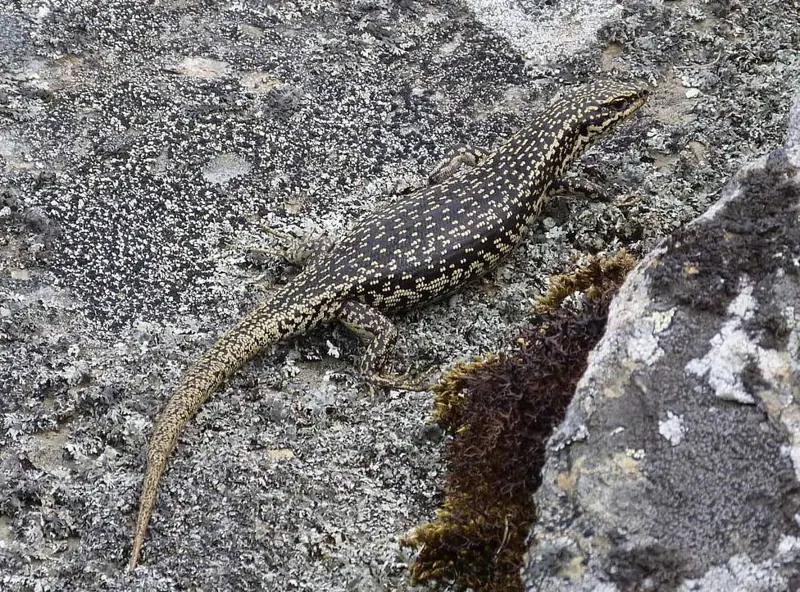

Placentas in lizards
Live birth comes in degrees. In many viviparous skinks the embryo still lives mostly on yolk, with only a simple placenta passing gases and water. At the other extreme, South American Mabuya skinks ovulate tiny eggs with almost no yolk. Nearly all of the embryo’s nourishment then arrives through a complex placenta, in a way that parallels mammals surprisingly closely.
Skinks caught in the act of changing
A handful of skinks are reproductively bimodal: some populations lay eggs and others give birth. The Australian three-toed skink, Saiphos equalis, is the famous case. Coastal populations lay eggs with well-developed embryos, while mountain populations give birth. In 2019 researchers reported a single female who laid eggs and then, several weeks later, gave birth to a live baby from the same litter. Lerista bougainvillii is another species with both modes.
Parental care
Most reptiles walk away from their eggs, but some skinks don’t. Female five-lined and broad-headed skinks of North America brood their clutches, curling around them and defending them. In family-living Australian species such as the gidgee skink and the Solomon Islands skink, young stay close to their parents for months or longer.
Tails: dropping them and growing them back
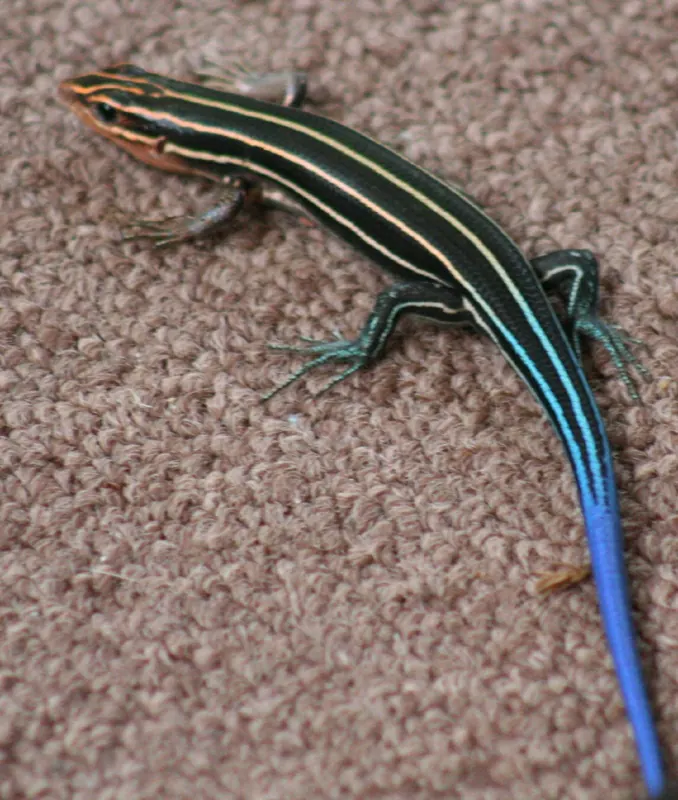

Most skinks can deliberately shed their tail, an ability called caudal autotomy. The tail vertebrae have built-in fracture planes, weak points where the bone, muscle and blood vessels are designed to separate cleanly. When a predator grabs the tail, the skink contracts muscles around one of these planes and the tail snaps off.
The shed tail doesn’t simply lie there. It thrashes and wriggles, and experiments with the little brown skink showed that this movement draws a predator’s attack to the tail and buys the lizard time to escape. The bright blue tails of many young skinks are thought to steer attacks towards this expendable part of the body.
Over time a new tail regrows. It is never quite the same. Instead of a chain of bony vertebrae, the replacement is supported by a single rod of cartilage, and its scales and colours are often different. You can usually spot a regrown tail by a change in pattern at the break point.
It is not free. A tail can be a fat store, and losing and regrowing one costs energy. Some big skinks, such as the shingleback, cannot drop their tails at all, and in those that can, a tail is a costly thing to lose. Either way, never pick up a skink by the tail.
Lizards that lost their legs
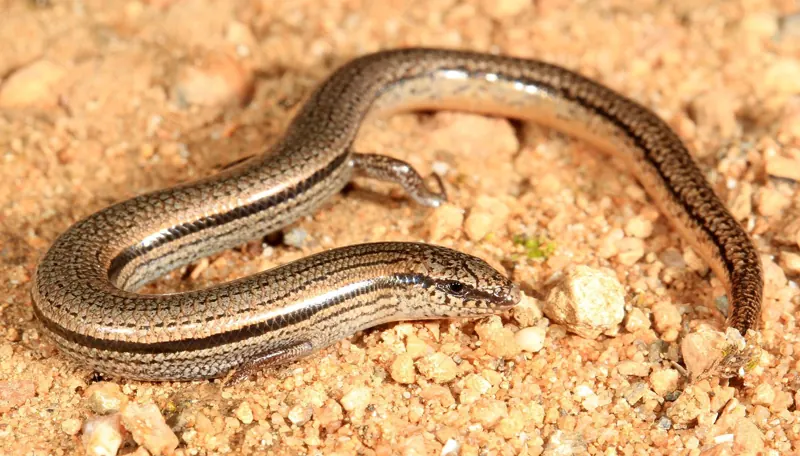

Snakes are not the only reptiles that gave up legs. Limb reduction has happened many times among lizards, and skinks are the champions: limbs have been reduced or lost an estimated 53–71 separate times in the family, and almost a quarter of skink species show some reduction. Across the family there are species with five toes on each foot, species with three, two or one, species with only hind legs, and species with no external limbs at all.
The trend is strongest in skinks that burrow through sand or soil or slide through dense grass, where legs get in the way and a long, slim body works better. As the limbs shrink, the body usually gets longer.
The Australian genus Lerista contains more than 90 species and shows almost every stage of this process. A 2008 analysis by Skinner, Lee and Hutchinson found at least ten independent reductions in toe number within the group, plus seven more from a four-toed ancestor and four complete losses of the digits, and estimated that complete loss could happen within 3.6 million years.
Closer to home, the Italian three-toed skink and its Chalcides relatives show the same story playing out around the Mediterranean.
Green blood
In the forests of New Guinea live skinks of the genus Prasinohaema, and a few relatives, whose blood is lime green. The colour comes from biliverdin, a bile pigment produced when red blood cells break down. These skinks carry concentrations far higher than the level that would make a human severely jaundiced. Their muscles, bones, tongue and mouth lining all show the same green tint.
A 2018 study led by Zachary Rodriguez, Christopher Austin and colleagues showed that green blood evolved independently at least four times. What it is for is still unknown. Resistance to blood parasites such as malaria has been suggested but not demonstrated.
Swimming through sand
The sandfish of the Sahara dives into loose sand and moves through it by wriggling its body in waves, with its legs folded against its sides. A 2009 study in Science by Ryan Maladen and colleagues at Georgia Tech used high-speed X-ray imaging to watch the motion and showed it works like undulatory swimming. The findings have since inspired sand-swimming robots.
Other defences
- The blue-tongue bluff: puffing up, hissing and flashing a bright tongue that also reflects ultraviolet light.
- Wedging: spiny skinks like the gidgee jam themselves into crevices and inflate their bodies.
- The decoy head: the shingleback’s blunt tail resembles its head, which may confuse a predator about which end to attack.
- Simply vanishing: diving under sand, leaf litter or a stone, the defence used by most skinks most of the time.