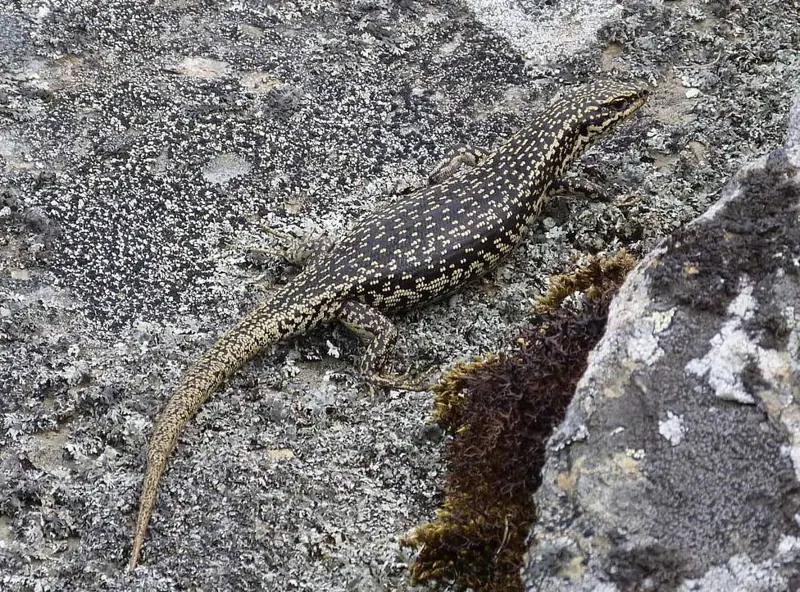

The grand skink lives on outcrops of schist rock in Otago’s tussock country, dashing between crevices and basking on warm stone. It is black with yellowish flecks, well camouflaged against the lichen-covered rock.
Introduced mammals such as cats, stoats and ferrets drove it into steep decline. Intensive predator trapping and predator-proof fencing at Macraes Flat, plus a translocated population at Mokomoko Sanctuary, have turned things round. In 2025 its New Zealand status improved from Nationally Endangered to Nationally Increasing, which is still officially “Threatened”.
New Zealand’s skinks are remarkable for another reason: nearly all of them give birth to live young. The only native egg-laying skink is the aptly named egg-laying skink, Oligosoma suteri.