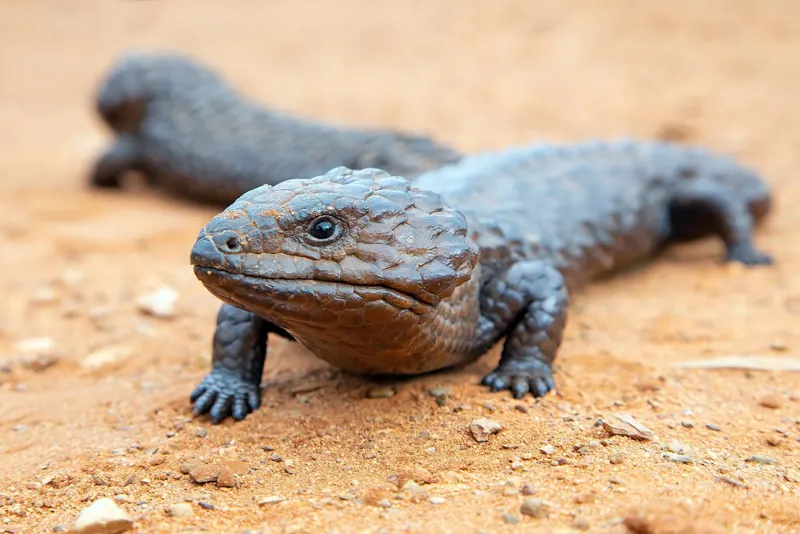

Few lizards have collected as many nicknames: bobtail, sleepy lizard, stumpy-tail, boggi, pine-cone lizard. The armour of big, rough scales and the fat, blunt tail that looks very much like a second head make the shingleback instantly recognisable. The tail doubles as a larder, storing fat for lean times.
Shinglebacks are the poster species for lizard monogamy. Long-term field studies in South Australia, led by the ecologist Michael Bull, followed the same pairs re-forming each spring for many years. The longest-studied pairs have stayed together for more than 20 years, one of them for 27. In the weeks before mating, a male shadows his partner closely, walking just behind her as she forages.
A female gives birth to a tiny family by lizard standards (usually two or three), but each baby is enormous, up to 22 cm long, by lizard standards and leaves its mother within days.
← Eastern blue-tongued skink · All species · Blotched blue-tongued skink →