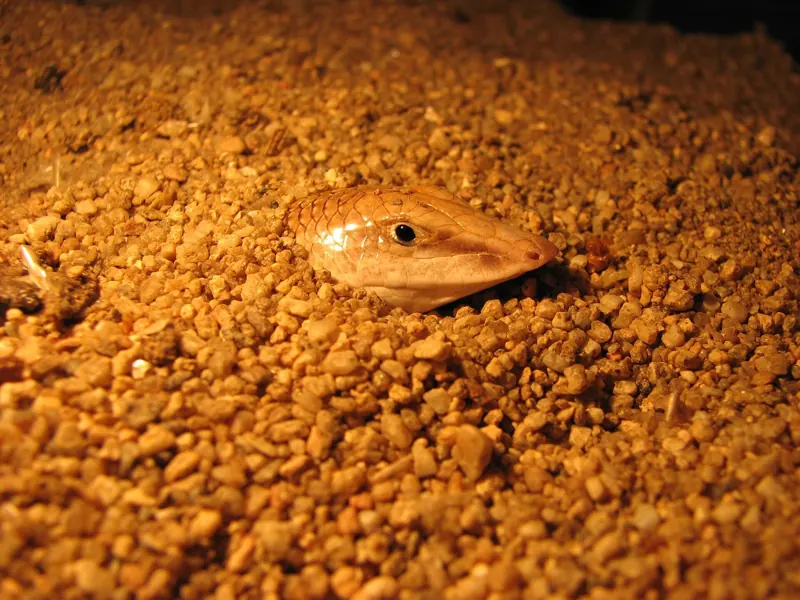

Almost everything about the sandfish is built for sand. It has a wedge-shaped, shovel-like snout, a countersunk lower jaw so grains can’t get into the mouth, flattened, fringed feet, small nostrils with a nasal passage that filters out sand, and smooth, shiny scales.
When it dives into a dune it tucks its legs against its body and wriggles like a fish. A 2009 study in Science used high-speed X-ray imaging to film this “sand-swimming”. The sandfish can also sense the vibrations of prey moving on the surface above.
The word “skink” itself comes, via Latin scincus, from the ancient Greek skinkos, a name for this very lizard. Dried sandfish were sold as medicine, which is why German speakers still call it the Apothekerskink, the pharmacist’s skink.